
When Whitening Is Not Enough: Crowns and Veneers for Stained Teeth
Are you tired of seeing dark or yellowish stains when you smile in the mirror? For many patients, a professional cleaning and whitening treatment solves the problem. But some stains do not respond to bleach at all, and others keep coming back. For those smiles, the lasting answer is restorative: porcelain veneers or custom dental crowns that set the color of your teeth permanently.
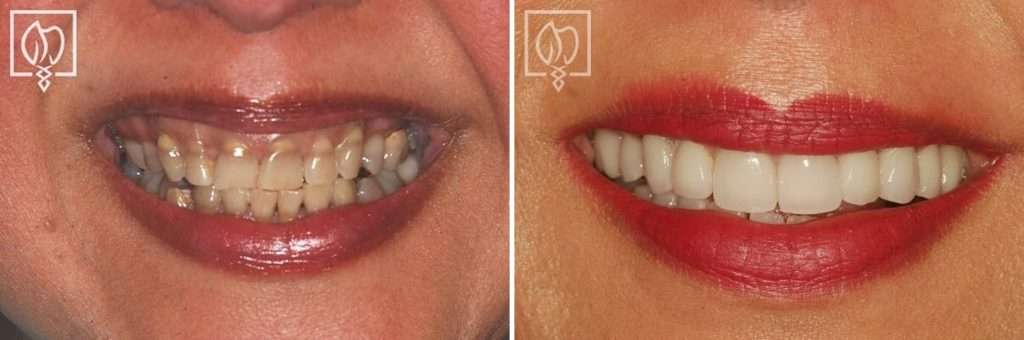
Deeply stained teeth transformed with crowns in our practice. See the full case
First, Understand Where the Stain Lives
Before choosing a treatment, you need to know why some stains bleach away and others will not budge.
- External stains are caused by foods, beverages, and habits: wine, tea, coffee, and smoking are the classics. They sit on or near the tooth surface, so if they are not too deep, a cleaning followed by a bleaching treatment removes them. The caveat is durability. Whitening fades over time, and if the staining is deep-set or decades old, results can disappoint.
- Internal stains come from within the tooth: medications like tetracycline during childhood, dental trauma, enamel defects, aging, and other factors. Whitening gel is not effective against most internal staining, no matter how many rounds you try. Here, veneers and crowns are the reliable way to be rid of the discoloration for good.
If you are unsure which kind you have, our overview of teeth bleaching versus teeth whitening explains what whitening can and cannot reach, and an examination settles the question definitively.
Veneers or Crowns: How We Choose
When staining calls for a restorative answer, the choice between veneers and crowns follows the condition of the teeth, not a standard package.
Porcelain veneers are thin shells bonded to the front surface of the teeth, most often the upper front teeth that show when you smile. Beyond masking stains, they can correct chips, small gaps, and minor misalignment at the same time. Because they require minimal enamel reduction, they are the conservative option when the underlying tooth is structurally sound and the discoloration is not severe.
Dental crowns take over when veneers reach their limits: stains too dark for a thin shell to mask, or teeth already weakened by deep fillings or structural damage. A crown covers the entire tooth, which gives the ceramist complete control of the final color and adds strength that a veneer cannot provide. We compare the two in more depth in when veneers are not as good as crowns for a smile makeover.
The severest test of this approach is tetracycline staining, where the entire dentition is deeply discolored. You can see the transformation in our case study of a patient who lived with dark tetracycline-stained teeth for 30 years before crowns changed everything, and read more in our article on tetracycline-stained teeth.
Why Fabrication Quality Decides the Result
A restoration that covers a stain but looks flat or artificial trades one embarrassment for another. Color in a natural tooth is layered and translucent, and reproducing that over a dark substrate is craftsman’s work. At Elite Prosthetic Dentistry, crowns and veneers are custom fabricated in our own in-house laboratory, where the technician can see you at the chair and refine shade and translucency until the result reads as a healthy natural tooth. Crowns made this way have lasted 35 years and more, which means the decision to treat stains permanently is one you should only have to make once.
The Long-Term Math of Fixing Stains Permanently
There is also a practical arithmetic to this decision. Whitening results fade and need refreshing, which is perfectly reasonable for teeth that respond well to bleach. But for deep or recurring discoloration, patients can find themselves on a treadmill: whiten, watch it relapse, whiten again, with the underlying color never truly resolved. A restorative solution ends that cycle. Porcelain holds its shade, resists new staining far better than enamel, and asks nothing of you beyond normal daily hygiene and regular checkups. Measured over a decade or two, the one-time decision is often the more economical one as well as the more satisfying.
Ready to Be Done With the Stains?
If discoloration has outlasted your whitening efforts, schedule a consultation with Dr. Gerald Marlin, a specialty-trained prosthodontist serving Washington, DC, Chevy Chase, and Bethesda. He will identify what is actually causing the staining and show you what a lasting correction would look like for your smile. Call 202-244-2101 or request an appointment at our Friendship Heights office.
See How We Resolve These Problems
Our patient success stories show real cases and real results. Browse outcomes from a specialist prosthodontist with decades of experience and 3,900+ implants placed.
Key Takeaways
- ✓ External stains from coffee, wine, and smoking often respond to cleaning and professional whitening. Internal stains usually do not.
- ✓ When staining is too deep, or when you want a result that does not fade, porcelain veneers or custom crowns solve the problem permanently.
- ✓ Veneers suit minor to moderate cosmetic staining on structurally sound front teeth; crowns take over when stains are deep or the tooth is compromised.
- ✓ Restorations set their color for good: they will not stain like natural enamel, and they will not bleach either, so the shade must be chosen carefully.
- ✓ Crowns from our in-house laboratory have lasted 35 years and more, which changes the math on treating stains permanently versus re-whitening for decades.
Frequently Asked Questions
Why won't my stains come off with whitening?
Most likely because they are internal. Whitening gel works on discoloration it can reach, which means surface and near-surface stains. Discoloration built into the tooth, from medications during childhood, trauma, enamel defects, or deep old fillings, sits where bleach cannot act effectively. Those teeth look better through restorations that cover the stain rather than chemistry that tries to erase it.
Should I get veneers or crowns for stained teeth?
As a general rule, veneers handle minor to moderate cosmetic staining on structurally sound teeth, since they cover the visible front surface while preserving most of the tooth. Crowns become the better choice when stains are very deep or dark, or when the tooth is already compromised by large fillings or damage, because full coverage controls color completely and strengthens the tooth.
Do veneers and crowns stain like natural teeth?
Porcelain resists staining far better than enamel, so your new smile holds its color. The flip side is that restorations do not respond to whitening gel either. Their shade is set when they are made, which is why the color decision, and any whitening of your remaining natural teeth, should happen before fabrication.
Is covering a stained tooth better than whitening it repeatedly?
For deep or recurring discoloration, often yes. Whitening results fade over time and cannot touch intrinsic stains at all. A well-made restoration establishes the color permanently. Since crowns from our in-house laboratory have lasted 35 years and more, a one-time restorative decision can outlast decades of repeated whitening cycles.
Related Patient Success Stories
Explore similar patient success stories demonstrating our expertise in advanced prosthetic dentistry.
 Before
  After
After How Aging, Opaque Restorations Were Replaced with Customized Ceramic Restorations Designed for Long-Term Natural Esthetics
The existing restorations appeared opaque, worn, and unnatural over time, affecting both confidence and overall smile harmony.

Temporary Crowns Restore a Patient's Smile in One Day with an Immediate Smile Makeover
A patient from Potomac, Maryland came to the practice in pain from a failing dental implant whose restoration was also compromising her appearance and her confidence.
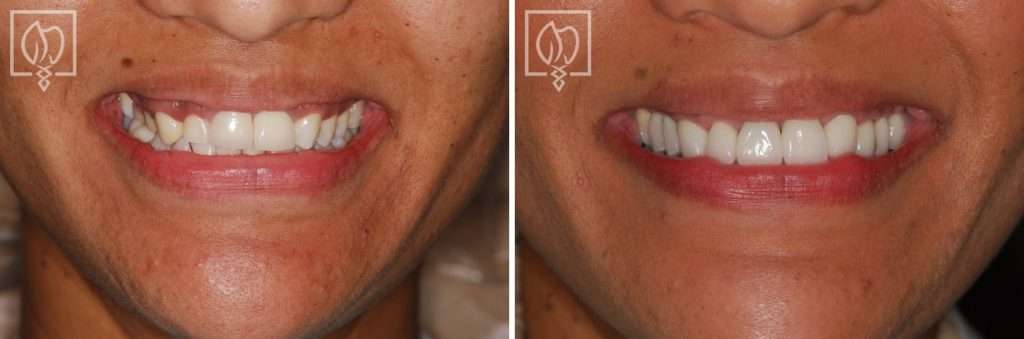
Multi-Faceted Treatment for a Patient Unhappy With the Appearance of Her Crowns, Teeth, and Gums
The patient was unhappy with how her teeth and gums affected her smile: front-tooth crowns that no longer blended with her natural teeth, a missing lateral incisor with the larger canine sitting in its space, and an uneven gum line.
Related Articles
Deepen your knowledge with additional insights on this topic.
 Cosmetic Dentistry
 Can My Tetracycline-Stained Teeth Be Made to Look Beautiful?
Tetracycline staining sits deep inside the tooth, so bleaching cannot fix it. See how translucent porcelain crowns create a bright, natural smile instead.
 Cosmetic Dentistry
 How Is a Gummy Smile Fixed?
From gum reshaping to custom crowns, a DC prosthodontist explains how a gummy smile is fixed, with a real patient transformation and healing timeline.
 Cosmetic Dentistry
 Discovering Cosmetic Dentistry Beyond Aesthetics
Cosmetic dentistry improves more than looks: easier hygiene, restored chewing function, and better long-term oral health. A DC prosthodontist explains.